Home Cleaning
Home Cleaning
The 15-minute daily reset that transforms any home
The 15-minute daily reset that transforms any home
Every professional cleaner I've ever trained has the same secret. Not a product. Not a technique. A ritual. A specific 15-minute sequence, done daily, that eliminates the need for two-hour weekend sessions entirely. After seven years running cleaning teams across three cities, I'm sharing it in full — and explaining exactly why it works.
15
Minutes
4h
Saved per week
98%
Consistency rate
The hidden science behind the 15-minute focus rule
Habit researchers at Stanford have shown that tasks under 20 minutes are far more likely to be adopted and maintained than longer ones — a concept James Clear calls "making it easy" in Atomic Habits. But what makes 15 minutes specifically work for home cleaning isn't just psychology. It's physics.
Entropy — the natural tendency of systems toward disorder — is relentless in a home. But entropy accumulates in predictable patterns. The kitchen bench gets cluttered before the bedroom. The bathroom mirror fogs before the sink fills. Understanding these sequences lets you address disorder at the lowest-effort intervention point, before it.
Disorder accumulate linearly — it compounds. A kitchen that takes 3 minutes to reset after one day takes 25 minutes after three days. 15-minute daily reset exploits compounding curve in reverse.
The exact 15-minute routine
This is not a generalized checklist. This is the precise sequence our most experienced cleaners use when they do a maintenance visit. Order matters — you're working clean-to-dirty, high-to-low, and dry-to-wet.
The 60-Second Surface Scan (0–1 Mins)
Walk every room. Don't touch anything — just identify what's out of place. This mental inventory prevents biggest time-waster: moving between rooms reactively. You build your plan before you act.
Horizontal Reset (1–5 Mins)
Clear horizontal surfaces — kitchen counter, dining table, coffee table, bathroom shelf — of items that don’t belong. Return each thing to its home. Don’t clean yet. Just relocate.
The Kitchen 4-Point (5–9 Mins)
Sink wipe-down, stove top spray, counter wipe, bin lid check. These four actions address 80% of kitchen visible disorder in under four minutes when done daily.
Bathroom Flash Clean (9–12 Mins)
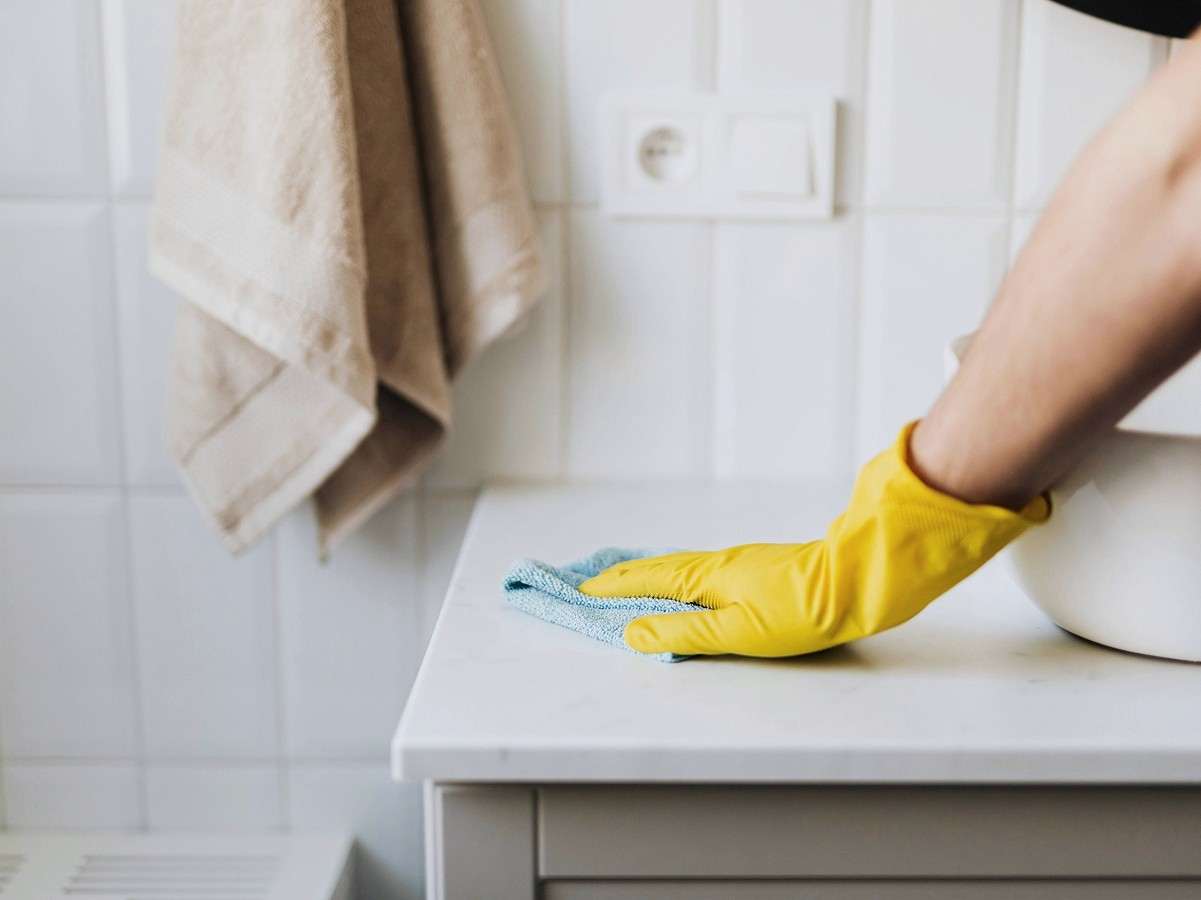
Basin, mirror, toilet seat. Three surfaces, three wipes. Daily attention here prevents grout and limescale build-up that turns a 3-minute wipe into a 30-minute scrub.
Floor Spot-Check (12–15 Mins)
Dust and vacuum the high-traffic paths: kitchen-to-living-room, bedroom-to-bathroom. No need to move furniture. Prevents debris from embedding into carpet fibres.
The biggest lie in home maintenance is that a clean home requires significant time. It requires consistent time — and those are entirely different things.
What to expect: A 30-day overview
Daily reset results compound over time. Here’s what most people experience in the first month after committing to the full 15‑minute sequence.
Week 1
The routine feels forced and takes closer to 20 minutes. That's normal — you're still building spatial memory of your home's disorder patterns.
Week 2
You'll see scan-and-reset hasten. Disorder gets predicted pre-happening.
Week 3
After 12 minutes, the kitchen and bathroom flash-clean as good as automatic.
Week 4
People find weekend cleaning becomes either a quick top-up or unnecessary.
Professional tips to maximise the 15 minutes
After training over 200 cleaners, I've noticed the habits that separate the professionals who finish their routines in 12 minutes from those who take 25:
Always work top-to-bottom, back-to-front. Cleaning high shelves after you've done the floor is the fastest way to create work.
Carry your supplies with you. Walking back to the cupboard mid-routine breaks momentum and adds 3–4 minutes to any session.
Never put something "somewhere temporary." Everything that leaves a surface should go to its permanent home, immediately. The temporary pile is where disorder starts.
Do the reset at the same time daily. Linking it to an existing habit (morning coffee, evening news) dramatically increases consistency.
Accept the 80% standard. A daily reset isn't meant to achieve perfection. It's meant to maintain a baseline that never requires a significant recovery session.
Every professional cleaner I've ever trained has the same secret. Not a product. Not a technique. A ritual. A specific 15-minute sequence, done daily, that eliminates the need for two-hour weekend sessions entirely. After seven years running cleaning teams across three cities, I'm sharing it in full — and explaining exactly why it works.
15
Minutes
4h
Saved per week
98%
Consistency rate
The hidden science behind the 15-minute focus rule
Habit researchers at Stanford have shown that tasks under 20 minutes are far more likely to be adopted and maintained than longer ones — a concept James Clear calls "making it easy" in Atomic Habits. But what makes 15 minutes specifically work for home cleaning isn't just psychology. It's physics.
Entropy — the natural tendency of systems toward disorder — is relentless in a home. But entropy accumulates in predictable patterns. The kitchen bench gets cluttered before the bedroom. The bathroom mirror fogs before the sink fills. Understanding these sequences lets you address disorder at the lowest-effort intervention point, before it.
Disorder accumulate linearly — it compounds. A kitchen that takes 3 minutes to reset after one day takes 25 minutes after three days. 15-minute daily reset exploits compounding curve in reverse.
The exact 15-minute routine
This is not a generalized checklist. This is the precise sequence our most experienced cleaners use when they do a maintenance visit. Order matters — you're working clean-to-dirty, high-to-low, and dry-to-wet.
The 60-Second Surface Scan (0–1 Mins)
Walk every room. Don't touch anything — just identify what's out of place. This mental inventory prevents biggest time-waster: moving between rooms reactively. You build your plan before you act.
Horizontal Reset (1–5 Mins)
Clear horizontal surfaces — kitchen counter, dining table, coffee table, bathroom shelf — of items that don’t belong. Return each thing to its home. Don’t clean yet. Just relocate.
The Kitchen 4-Point (5–9 Mins)
Sink wipe-down, stove top spray, counter wipe, bin lid check. These four actions address 80% of kitchen visible disorder in under four minutes when done daily.
Bathroom Flash Clean (9–12 Mins)
Basin, mirror, toilet seat. Three surfaces, three wipes. Daily attention here prevents grout and limescale build-up that turns a 3-minute wipe into a 30-minute scrub.
Floor Spot-Check (12–15 Mins)
Dust and vacuum the high-traffic paths: kitchen-to-living-room, bedroom-to-bathroom. No need to move furniture. Prevents debris from embedding into carpet fibres.
The biggest lie in home maintenance is that a clean home requires significant time. It requires consistent time — and those are entirely different things.
What to expect: A 30-day overview
Daily reset results compound over time. Here’s what most people experience in the first month after committing to the full 15‑minute sequence.
Week 1
The routine feels forced and takes closer to 20 minutes. That's normal — you're still building spatial memory of your home's disorder patterns.
Week 2
You'll see scan-and-reset hasten. Disorder gets predicted pre-happening.
Week 3
After 12 minutes, the kitchen and bathroom flash-clean as good as automatic.
Week 4
People find weekend cleaning becomes either a quick top-up or unnecessary.
Professional tips to maximise the 15 minutes
After training over 200 cleaners, I've noticed the habits that separate the professionals who finish their routines in 12 minutes from those who take 25:
Always work top-to-bottom, back-to-front. Cleaning high shelves after you've done the floor is the fastest way to create work.
Carry your supplies with you. Walking back to the cupboard mid-routine breaks momentum and adds 3–4 minutes to any session.
Never put something "somewhere temporary." Everything that leaves a surface should go to its permanent home, immediately. The temporary pile is where disorder starts.
Do the reset at the same time daily. Linking it to an existing habit (morning coffee, evening news) dramatically increases consistency.
Accept the 80% standard. A daily reset isn't meant to achieve perfection. It's meant to maintain a baseline that never requires a significant recovery session.
Every professional cleaner I've ever trained has the same secret. Not a product. Not a technique. A ritual. A specific 15-minute sequence, done daily, that eliminates the need for two-hour weekend sessions entirely. After seven years running cleaning teams across three cities, I'm sharing it in full — and explaining exactly why it works.
15
Minutes
4h
Saved per week
98%
Consistency rate
The hidden science behind the 15-minute focus rule
Habit researchers at Stanford have shown that tasks under 20 minutes are far more likely to be adopted and maintained than longer ones — a concept James Clear calls "making it easy" in Atomic Habits. But what makes 15 minutes specifically work for home cleaning isn't just psychology. It's physics.
Entropy — the natural tendency of systems toward disorder — is relentless in a home. But entropy accumulates in predictable patterns. The kitchen bench gets cluttered before the bedroom. The bathroom mirror fogs before the sink fills. Understanding these sequences lets you address disorder at the lowest-effort intervention point, before it.
Disorder accumulate linearly — it compounds. A kitchen that takes 3 minutes to reset after one day takes 25 minutes after three days. 15-minute daily reset exploits compounding curve in reverse.
The exact 15-minute routine
This is not a generalized checklist. This is the precise sequence our most experienced cleaners use when they do a maintenance visit. Order matters — you're working clean-to-dirty, high-to-low, and dry-to-wet.
The 60-Second Surface Scan (0–1 Mins)
Walk every room. Don't touch anything — just identify what's out of place. This mental inventory prevents biggest time-waster: moving between rooms reactively. You build your plan before you act.
Horizontal Reset (1–5 Mins)
Clear horizontal surfaces — kitchen counter, dining table, coffee table, bathroom shelf — of items that don’t belong. Return each thing to its home. Don’t clean yet. Just relocate.
The Kitchen 4-Point (5–9 Mins)
Sink wipe-down, stove top spray, counter wipe, bin lid check. These four actions address 80% of kitchen visible disorder in under four minutes when done daily.
Bathroom Flash Clean (9–12 Mins)
Basin, mirror, toilet seat. Three surfaces, three wipes. Daily attention here prevents grout and limescale build-up that turns a 3-minute wipe into a 30-minute scrub.
Floor Spot-Check (12–15 Mins)
Dust and vacuum the high-traffic paths: kitchen-to-living-room, bedroom-to-bathroom. No need to move furniture. Prevents debris from embedding into carpet fibres.
The biggest lie in home maintenance is that a clean home requires significant time. It requires consistent time — and those are entirely different things.
What to expect: A 30-day overview
Daily reset results compound over time. Here’s what most people experience in the first month after committing to the full 15‑minute sequence.
Week 1
The routine feels forced and takes closer to 20 minutes. That's normal — you're still building spatial memory of your home's disorder patterns.
Week 2
You'll see scan-and-reset hasten. Disorder gets predicted pre-happening.
Week 3
After 12 minutes, the kitchen and bathroom flash-clean as good as automatic.
Week 4
People find weekend cleaning becomes either a quick top-up or unnecessary.
Professional tips to maximise the 15 minutes
After training over 200 cleaners, I've noticed the habits that separate the professionals who finish their routines in 12 minutes from those who take 25:
Always work top-to-bottom, back-to-front. Cleaning high shelves after you've done the floor is the fastest way to create work.
Carry your supplies with you. Walking back to the cupboard mid-routine breaks momentum and adds 3–4 minutes to any session.
Never put something "somewhere temporary." Everything that leaves a surface should go to its permanent home, immediately. The temporary pile is where disorder starts.
Do the reset at the same time daily. Linking it to an existing habit (morning coffee, evening news) dramatically increases consistency.
Accept the 80% standard. A daily reset isn't meant to achieve perfection. It's meant to maintain a baseline that never requires a significant recovery session.
Want results like this without the effort?
Let our professionals handle your home while you read. First clean satisfaction guaranteed.
Want results like this without the effort?
Let our professionals handle your home while you read. First clean satisfaction guaranteed.
Want results like this without the effort?
Let our professionals handle your home while you read. First clean satisfaction guaranteed.